
Pro tips
How long should you rest between sets? The 60-second rule, checked
Is "rest a minute to build muscle" backed by research? A 2024 meta-analysis suggests a possible small size benefit from resting longer than 60 seconds, and one small trial found more strength with 3-minute rests. Here is what that means for your rest timer this week.
Listen to this post · read by Connor
You've heard the rule: rest about a minute between sets to build muscle. Does the research back it up?
Not really. A 2024 review suggests a possible small muscle-size benefit from resting longer than 60 seconds, and one small trial found more strength with 3-minute rests than 1-minute rests. Whether going past 90 seconds helps size is unclear. Here is what the studies found and what to do with it this week.
What the research found
An 8-week trial in trained men. Twenty-one young, resistance-trained men completed the same program three days a week: seven exercises per session, 3 sets of 8 to 12 repetition maximum (RM, meaning a load you could lift for about that many reps at the limit). One group rested 1 minute between sets (11 men), the other 3 minutes (10 men); two men dropped out. The men trained every set to momentary concentric failure, which is more than the "stop a rep or two short" cue below, so the results may not carry over to that style. The 3-minute group improved more on squat and bench press one-rep max. It also gained more thickness at the front of the thigh (ultrasound, p = .04). The triceps leaned the same way but missed the usual cutoff (p = .06). Both groups improved on the one endurance test, bench press reps to failure at 50% of starting one-rep max, and the difference between groups was not statistically significant. Measured volume load (the sum of weight × reps across sets) for the three barbell lifts tracked in each week's final session did not differ significantly between groups (p = .18) (Schoenfeld et al., 2016).
How strong is this? One small randomized trial in young trained men, 8 weeks. It says nothing direct about women, beginners or older adults, and no single trial settles a question.
A 2024 meta-analysis on muscle size. Researchers pooled nine randomized studies (19 measurements: 10 thigh, 6 arm, 3 whole body; interventions of 5 to 10 weeks) that compared rest durations in controlled resistance-training programs, with matched set volume or volume load required. They concluded that resting longer than 60 seconds may give a small size benefit, and that whether going beyond 90 seconds adds anything is unclear. The longer-versus-shorter estimates, in standardized units, were small and uncertain: arm +0.13 (95% credible interval -0.27 to +0.51), thigh +0.17 (-0.13 to +0.43), and whole body -0.08 (-0.45 to +0.29). The whole-body figure, which leans slightly toward shorter rest, comes from a univariate analysis of just three measurements; the multivariate version leaned slightly toward longer rest (+0.03, -0.28 to +0.36). Every interval crosses zero. The authors suggest longer rests may help because they preserve the weight or reps you complete across sets. That is a hypothesis, not something the paper tested (Singer et al., 2024).
How strong is this? A preregistered systematic review of nine studies, with substantial heterogeneity (results varied a lot between studies). Six studies used untrained participants and three used resistance-trained ones. One study was women-only, one mixed-sex, six men-only and one did not specify sex; one study was in adults over 65. So the findings may not apply well to trained lifters, women or older adults. It analyzed muscle size only, not strength.
What ACSM said. In its 2009 position stand, the American College of Sports Medicine recommended "heavy loading (1-6 RM) using 3- to 5-min rest periods between sets performed at a moderate contraction velocity" for intermediate to advanced trainees using periodized training (ACSM, 2009). "1-6 RM" describes the load: a weight you could lift only about one to six times. It is not an instruction to take every set to failure. For hypertrophy in novice to intermediate trainees, the same stand suggested 1 to 2 minutes of rest (evidence category C). ACSM updated its position stand in March 2026. That overview of reviews found insufficient data to determine whether rest between sets affects muscle size, and did not find a strength difference in its broad short (under 1 minute) versus long (over 1 minute) comparison. That comparison does not set a specific rest prescription for heavy sets in trained lifters (ACSM, 2026).
What this does and doesn't show
The evidence is early and mixed. There is a possible small size benefit past 60 seconds, one small trial favoring 3 minutes for strength and thigh size, and a newer position stand that calls the size question unresolved. Nothing here shows that 1-minute rests are harmful, or that 3 minutes is necessary.
What to do this week
These are coaching starting points, not tested prescriptions. The exact numbers, the reps-in-reserve cue and the pairing rules are my judgment, and you should adjust them to how you feel. The 2026 ACSM stand says training to failure is not obligatory for results, and that the evidence is insufficient to name an exact reps-in-reserve target.
- Big compound lifts (squat, deadlift, bench, rows, overhead press): try 2 to 3 minutes. For heavy sets of about 1 to 6 reps, 3 minutes or more is reasonable. Longer rests may help keep your weight or reps up on later sets, which is the authors' hypothesis, not a tested result.
- Watch your reps. If reps drop sharply from set to set, try a little more rest or lower the weight. Rep drop-off can also come from a load that is too heavy or from training to failure. Stopping a rep or two before failure is a reasonable starting point on heavy lifts (ACSM 2026 says failure is optional and the evidence is insufficient for exact reps-in-reserve targets: ACSM, 2026). Use safeties or a spotter on squat and bench, and lower the weight rather than grind.
- Smaller or single-joint moves (curls, lateral raises, triceps work): 60 to 90 seconds is a fair starting point. These are typically less fatiguing (coaching judgment). If you need more, take it.
- Short on time? Don't shorten rests on your hardest lift. Cut a set from a lower-priority exercise instead, or superset: do exercise A, then B straight away, then rest 2 to 3 minutes. Pair exercises with different movement patterns (a press with a row or a curl), and make the second exercise lighter or lower priority. Avoid pairing two heavy lifts that load the spine, grip or legs (squat plus deadlift, deadlift plus heavy rows). Keep your hardest lift first and fresh.
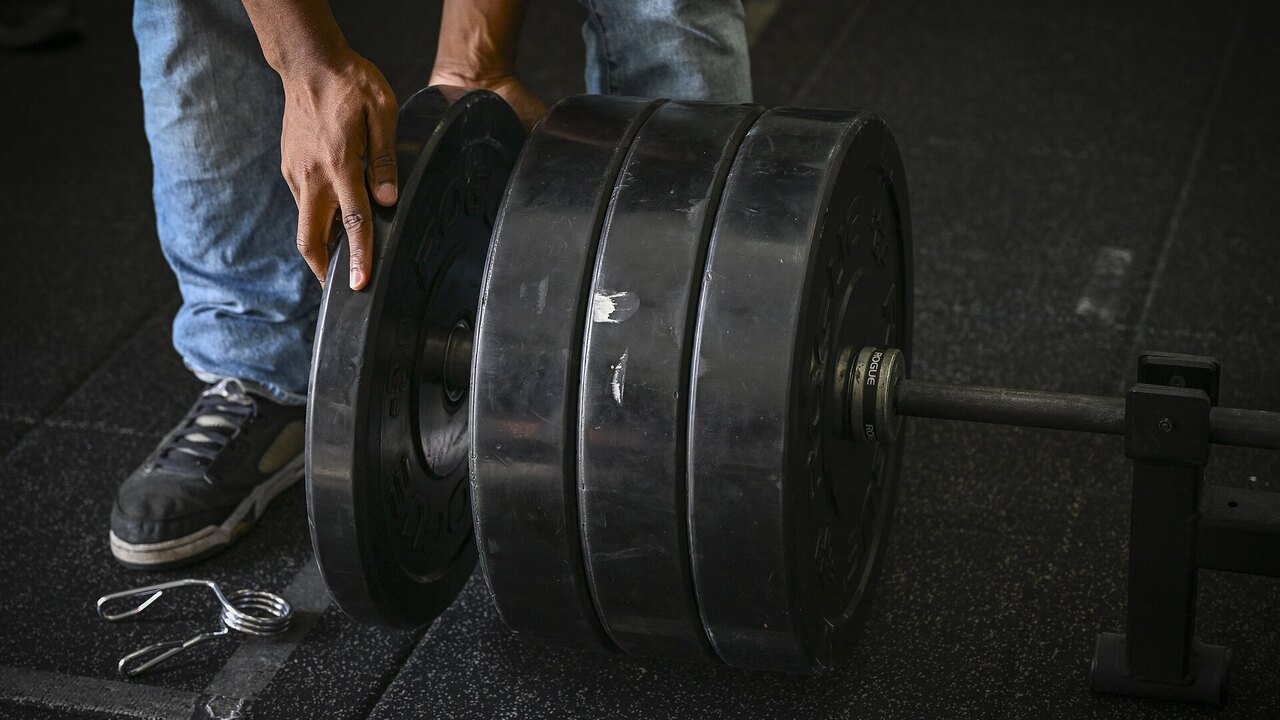
- Use the rest. Re-rack the weights before you walk away. Walk around, sip water, and breathe normally during sets. In a small study of 20 novice male lifters, holding the breath (Valsalva) during an arm curl and knee extension produced the highest blood pressure responses (Linsenbardt et al., 1992). If you have a heart or blood pressure condition, ask your doctor about lifting.
- If you feel dizzy or unwell, stop and sit or lie down rather than stand. If dizziness keeps happening, see a doctor. If it comes with warning signs such as chest pain, fainting, trouble breathing, a rapid or irregular heartbeat, a sudden severe headache, or blurred or double vision, call your local emergency number or seek emergency medical care (Mayo Clinic symptom checker; symptoms; when to see a doctor).
One caveat for endurance work: in its 2009 stand, ACSM listed shorter rests for local muscular endurance, with different examples for different rep ranges and short transitions for circuits (evidence category C; ACSM, 2009). So for high-rep or circuit training, shorter rests are a legitimate choice. This post's research is about strength and muscle size. The Schoenfeld trial measured one upper-body endurance outcome and found no significant group difference.
This post is general information, not medical advice. If you have an injury or health condition, check with your doctor or a qualified professional before changing your training.
Sources
- Longer Interset Rest Periods Enhance Muscle Strength and Hypertrophy in Resistance-Trained Men (J Strength Cond Res, 2016) — study
- Give it a rest: a systematic review with Bayesian meta-analysis on the effect of inter-set rest interval duration on muscle hypertrophy (Front Sports Act Living, 2024) — meta-analysis
- ACSM position stand: Progression models in resistance training for healthy adults (Med Sci Sports Exerc, 2009) — position-stand
- ACSM position stand: Resistance training prescription for muscle function, hypertrophy, and physical performance in healthy adults: an overview of reviews (Med Sci Sports Exerc, 2026) — position-stand
- Effect of breathing techniques on blood pressure response to resistance exercise (Br J Sports Med, 1992) — study
- Mayo Clinic: Dizziness in adults symptom checker — guideline
- Mayo Clinic: Dizziness symptoms and causes — guideline
- Mayo Clinic: Dizziness diagnosis and treatment — guideline
Fact-checked by two independent reviewers on . Every claim links to its source in the Sources list above.
General fitness information, not medical advice. Check with your doctor before starting something new, especially with an injury, a health condition or during pregnancy.
Want a plan built around you?
Train with me in person or virtually, no membership needed.
Keep reading
More from the blog

No time to work out? Try exercise snacks
Short bursts of movement, a minute or two at a time, can measurably improve fitness in people who don't exercise. Here's what the research shows and 10 easy exercise snacks to try.
The first sub-2-hour marathon in a real race, and what it teaches the rest of us
Sabastian Sawe ran 1:59:30 at the London Marathon, the first sub-two in a record-eligible race. Outside just named him an Outsider of the Year. Here's what happened and what everyday runners can take from it.