
Myth busting
Tarot began as a card game. Here is what that changes (and what it doesn't)
Tarot is often called "ancient Egyptian wisdom". The record shows 15th-century Italian card games, an influential 1781 Egyptian theory with no historical evidence behind it, and a 1909 deck that shaped modern reading. Plus a 10-minute way to read one card this week.
Listen to this post · read by Connor
If you have ever heard that tarot is "an ancient Egyptian book of wisdom, hidden for thousands of years", you have heard a popular modern version of an old story. An influential version of that idea appeared in print in 1781. The real history is more surprising, and it makes tarot easier to approach, not harder.
This post keeps three things apart: what history shows, what tarot readers believe, and what you can try yourself.
What history shows: it started as a game
The earliest records and surviving cards place tarot in 15th-century Italy, with references from the 1440s and 1450s. Milan, Ferrara, Florence and Bologna were all early centres. The new idea was a series of extra picture cards, called trionfi ("triumphs"), added to the ordinary four-suit pack of the time; these are the origin of the "trumps" in English card games. The point of the deck was to play a trick-taking game, a family of games still played today.
By the early 1500s, forms of the name tarot appear in the written record. Earlier records call the cards trionfi. Among the oldest surviving decks are hand-painted Milanese court cards of the mid-15th century, made for the city's ruling families, such as the Visconti-Sforza cards.
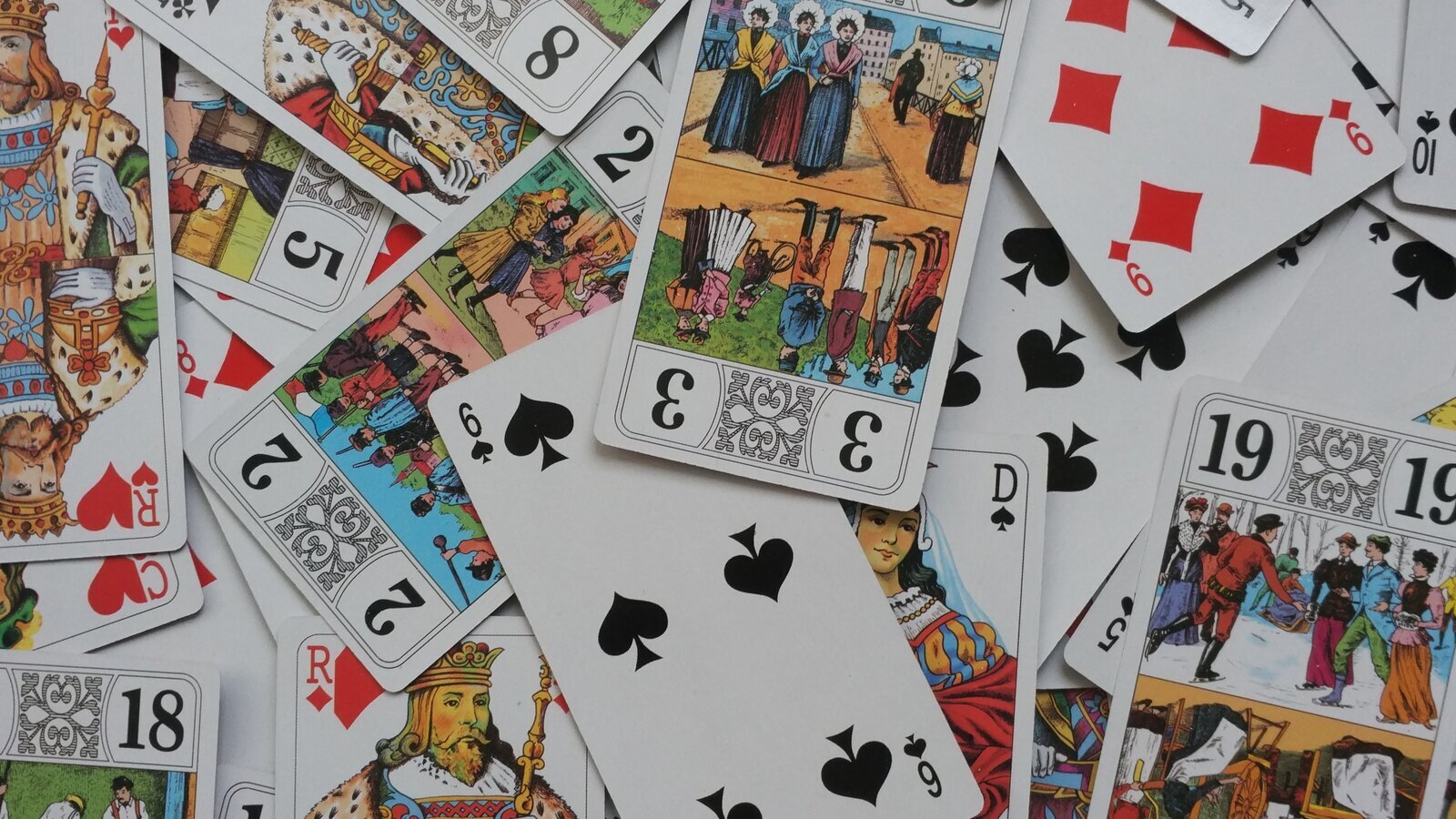
Tarot card games never really went away. French Tarot is still played in organised clubs: the French Tarot federation reports about 9,900 affiliated players and more than 366 affiliated clubs in 2026. The cover photo of this post shows a modern game deck.
What history shows: the "ancient Egypt" idea has a date
In 1781 a French Protestant pastor and scholar, Antoine Court de Gébelin, published an essay on tarot in volume 8 of his large work Le Monde primitif. It is an influential published version of the idea that tarot was a surviving Egyptian book of priestly wisdom. He offered symbolic readings and guesses about word origins, but no historical evidence connecting tarot to ancient Egypt. Champollion published his breakthrough on reading Egyptian hieroglyphs in 1822. An essay in the same volume, signed "M. le C. de M." and attributed to the Comte de Mellet, went further and claimed the Egyptians used the cards to tell fortunes and gave a method for reading them. It supplied no historical evidence tying tarot to ancient Egyptian divination.
Two years later a Parisian professional known as Etteilla (Jean-Baptiste Alliette) began publishing a tarot manual in installments in 1783, separate from his earlier manual on ordinary playing cards. He is usually described as one of the earliest documented professional tarot readers, and by the late 1780s he had designed one of the earliest known tarot packs made specifically for divination. Stronger "first ever" labels rest on a small number of sources, and they do not mean nobody had used existing tarot cards this way before. The idea of tarot as a tool for reading, rather than only for playing, took shape in France in these decades.
Then in 1909 the London publisher William Rider & Son released a deck designed by the occultist A. E. Waite and painted by artist Pamela Colman Smith, both members of the Hermetic Order of the Golden Dawn. Smith illustrated every card, including the numbered suit cards. It has influenced many later decks. Many readers now call it the Rider-Waite-Smith deck to credit her.
What tarot readers believe
This is where the story gets interesting, and it is a matter of belief and practice rather than history. Some modern readers use tarot as a prompt for reflection, a way to notice patterns in their own thinking or to tell a story about a question. Others hold spiritual beliefs about the cards, such as that they connect to something beyond the reader. Both are real approaches with real communities, and this post does not claim to know how many people hold each view.
A few honest limits. A late origin does not make a practice meaningless, and an old origin would not have made it true. The historical sources here tell us where the cards came from. They offer no evidence that cards predict events, and the exercise below does not rely on prediction: it uses one card as a prompt for your own reflection.
Try it: one card, ten minutes
You can use any deck. If you have no deck, the original 1909 Rider-Waite-Smith images are in the public domain in the US and UK and are widely available online. Newer editions and re-colored versions can still be under copyright, so check before you reuse one.
- Ask a small, open question (1 minute). Choose something like "What would help me stay steady this week?" Avoid yes/no questions and questions about other people's private lives.
- Draw one card (1 minute). Shuffle however you like and turn over the top card.
- Describe, don't interpret (3 minutes). Out loud or on paper, list only what you can see: colors, figures, what they are doing, the weather, the mood.
- Connect it (3 minutes). Ask: where in my week does this picture show up? What is it inviting me to notice?
- Pick one small action (1 minute). Something you can do in five minutes. Write it down.
- Close (1 minute). Put the card back in the deck. Take three slow breaths and feel your feet on the floor. Say out loud one thing in the room you can see.
How often: entirely optional, and there is no "right" amount. If you enjoy it, once a week is plenty. What to expect: a prompt for your own thinking, not an answer from outside.
Who should be careful
For many people tarot is a tool for reflection, and for others a spiritual practice or simply entertainment. It is not medical, mental-health or legal advice, and a card cannot tell you whether to start, stop or change any treatment or major decision. Skip the exercise or stop part-way if a card or a question stirs up something painful and you do not feel steady. If you are in distress or thinking about harming yourself, contact a doctor or therapist, or call your local emergency number if you are in immediate danger, or a crisis line (in the US, call or text 988; elsewhere, findahelpline.com lists services by country). Never let a reading push you into a decision. This one-card exercise teaches no initiation and no rite that belongs to a particular community. If you are drawn to community-specific or initiatory practices, approach them through the guidance of their own practitioners rather than copying them from the internet. If a reader frightens you, tells you that you are cursed, or pressures you to pay, walk away.
For a reading that stays within these lines, see our tarot service or browse Learn.
Sources
- Yale University Library: In the cards, early Visconti-Sforza tarocchi decks (c. 1440-1480; a trick-taking game; fortune telling from the 18th century) — other
- Tarot (Wikipedia, with cited references to Dummett and others) — other
- Visconti-Sforza Tarot (Wikipedia) — other
- Court de Gébelin, Le Monde primitif vol. 8 (1781), tarot essay from p. 365, Mellet essay from p. 395 (Internet Archive scan) — other
- Antoine Court de Gébelin (Wikipedia) — other
- French Tarot Federation (FFT): affiliated players and clubs — other
- Etteilla, Manière de se récréer avec le jeu de cartes nommées tarots (1783; BnF catalogue) — other
- Etteilla, Livre de Thot, Basan prints (c. 1788-89; BnF catalogue record) — other
- The World in Play: Luxury Cards 1430-1540 (Metropolitan Museum of Art) — other
- Victoria and Albert Museum: Tarot cards — other
- Etteilla (Wikipedia, a starting point only) — other
- Etteilla's Livre de Thot Tarot, ca. 1789 (The Public Domain Review) — other
- Rider-Waite Tarot, first published 1909 by William Rider & Son (Wikipedia) — other
- Decker, Depaulis and Dummett, A Wicked Pack of Cards: The Origins of the Occult Tarot (Duckworth, 2002 impression of the 1996 edition), pp. 92 and 94 on Etteilla's 1789 pamphlet, the estimated 1788 design and engraving date, and his pack as the first commercially available cartomantic tarot pack — other
- Cover photo: Cards of French Tarot by 立直, Wikimedia Commons, licence CC BY-SA 4.0 (file page) — other
Fact-checked by two independent reviewers on . Every claim links to its source in the Sources list above.
Spiritual practice and education, not medical or mental-health advice, and not a substitute for a doctor or therapist. Try only what feels safe for you, and stop if something feels wrong. Beliefs and traditions are described as beliefs, not as proven fact.
Want to go deeper?
Book a reading or a session, or start with a free consultation. Spirit communication is a skill you can learn.